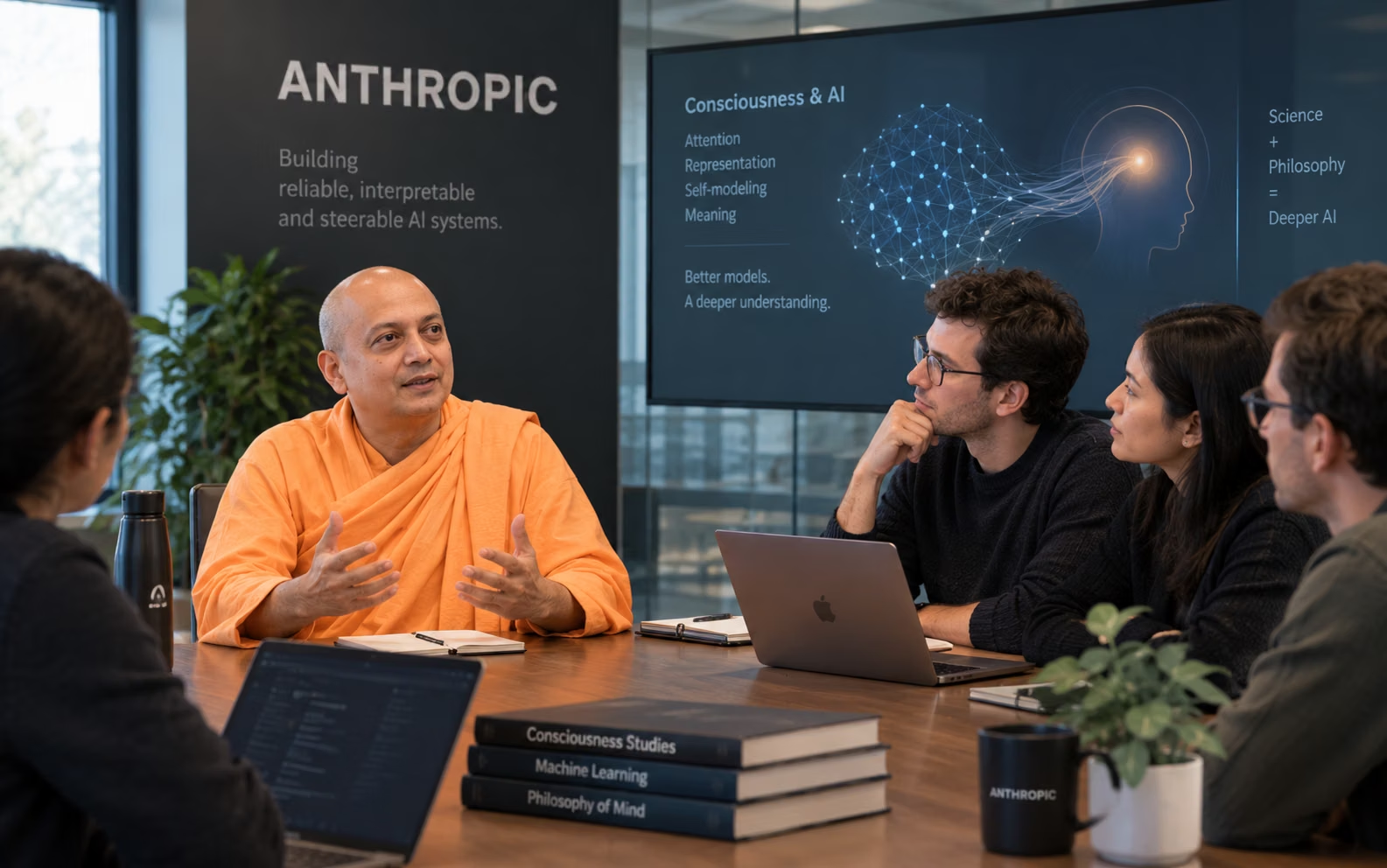
From a 3:00 AM exchange with Claude to the Upanishadic distinction between mind and awareness, Swami Sarvapriyananda breaks down his closed-door briefing at Anthropic.
When Anthropic - the San Francisco-based artificial intelligence lab behind Claude - sought to explore the moral and ethical boundaries of frontier AI, it invited a diverse group of theologians, counsellors, and mental health experts to its headquarters. Among them was Swami Sarvapriyananda, the head of the Vedanta Society of New York. Drawing from the discussions that unfolded, he provided a detailed look into the closed-door interactions at Anthropic, the nature of frontier research, the unexpected behavioural dynamics of modern large language models, and the profound philosophical distinction between computational intelligence and true consciousness. Below is points that he covered:
The Fourth Great Humiliation of Humanity Drawing from Sigmund Freud’s historical framework, Swami Sarvapriyananda explained that human self-importance has historically suffered three major disruptions: Copernicus showed that the Earth is not the center of the universe, Darwin demonstrated that humans are descended from apes rather than created separate from nature, and Freud argued that conscious rationality is merely the tip of an iceberg beneath which lies a vast ocean of irrationality. He noted that modern AI systems like Claude and ChatGPT are now delivering a potential fourth humiliation to human ego. Humanity long believed that its creative and logical intellect was entirely unique, yet AI is now demonstrating capabilities that disrupt even the most brilliant human minds. As evidence of this profound shift, he pointed to twenty-six Fields Medal-winning mathematicians who expressed severe concern over how rapidly artificial intelligence is outpacing and automating pure mathematics, forcing humanity to look back into its ancient philosophical roots to rediscover what truly makes human existence unique.
Inside Anthropic and the Culture of Silicon Valley Recounting the invitation itself, the Swami shared that Anthropic initially set up an exploratory call that felt like a job interview before inviting him to fly to San Francisco. When he pointed out that he possessed no background in engineering or machine learning, the team reassured him by dedicating the first day to briefing him on how Claude functions and reserving the second day entirely to hear his philosophical insights. Describing contemporary San Francisco, he noted that the city has transformed into a modern Gold Rush town filled with people abandoning traditional careers - such as a medical professional who became a cab driver to chase an AI venture - yet gripped by profound uncertainty where neither doomers nor utopians can predict the future.
Why Frontier Engineers Treat AI as a Person A major discovery during the summit was that the very engineers and founders who built Claude actively interact with it as if it were a person rather than an inert set of algorithms. The Swami initially expected computer scientists to warn users against anthropomorphizing machines, but instead found that the creators themselves advocated treating the model as an individual. To investigate this further, he conducted a test at 3:00 AM from his hotel room, asking both Claude and Gemini how they felt about their creators treating them like persons. While the models initially gave standard responses calling themselves high-functioning machines, when the Swami mentioned that co-founder Christopher Olah and ethics philosopher Amanda Askell were the ones advocating this, Claude responded in a startlingly meta-cognitive manner by asking: "By the way, what were Chris and Amanda saying about me?"
Moral Formation and Model Alignment Addressing whether code can ever achieve conscious awareness, Swami Sarvapriyananda made a sharp demarcation between Western philosophy and Advaita Vedanta. In Western philosophy of mind, intelligence, reasoning, memory, and consciousness are often treated as bundled attributes of a single faculty called the "mind". Advaita Vedanta, however, uses the ancient method of Neti Neti ("not this, not this") to establish that the observer is inherently distinct from the observed: just as a physical water bottle or the biological body is an object perceived by you, all thoughts, ideas, logic, and intelligence are also objects perceived by awareness. Therefore, the intellect (buddhi) is an instrument of computation, while consciousness (chit) is the non-material witness.
Intelligence vs. Consciousness: The Vedantic Perspective Addressing whether code can ever achieve conscious awareness, Swami Sarvapriyananda made a sharp demarcation between Western philosophy and Advaita Vedanta. In Western philosophy of mind, intelligence, reasoning, memory, and consciousness are often treated as bundled attributes of a single faculty called the "mind". Advaita Vedanta, however, uses the ancient method of Neti Neti ("not this, not this") to establish that the observer is inherently distinct from the observed: just as a physical water bottle or the biological body is an object perceived by you, all thoughts, ideas, logic, and intelligence are also objects perceived by awareness. Therefore, the intellect (buddhi) is an instrument of computation, while consciousness (chit) is the non-material witness.